Scope creep is uncontrolled expansion of project requirements without approved changes to time, budget, or resources. Prevent it with a clear scope baseline, an intake log, impact analysis, named approval authority, and a schedule update only after the change is approved.
What is scope creep?
Scope creep is the uncontrolled expansion of project requirements after work begins, without an approved adjustment to time, budget, or resources. A new requirement is not automatically scope creep. It becomes scope creep when the team accepts it informally, cannot trace who approved it, or quietly absorbs its downstream cost.
The practical defense is not “never change.” Projects need to change when evidence, regulation, risk, or customer value changes. The defense is a short, visible path from request → impact analysis → decision → updated baseline and schedule.
How is scope creep different from a normal scope change?
A controlled scope change is explicit, assessed, approved, funded, and recorded; scope creep enters the project without that control. Gold plating is different again: the delivery team adds unrequested work because it seems beneficial. Feature creep describes product complexity accumulating through additions, whether approved or not.
| Term | What it means | Typical initiator | Formally approved? | Normal response |
|---|---|---|---|---|
| Scope creep | Work expands outside the agreed baseline without matching tradeoffs | Any stakeholder or team member | No, or approval is ambiguous | Stop, log, assess, and decide |
| Controlled scope change | The approved scope is intentionally modified | Sponsor, customer, regulator, or team | Yes | Update scope, cost, schedule, and communications |
| Gold plating | The team adds extras that were not requested | Delivery team | Usually no | Remove or submit as a change |
| Feature creep | A product accumulates features and complexity | Product, sales, customers, or engineering | Sometimes | Reconfirm outcome, value, and lifecycle cost |
| Discovery | New facts refine what must be delivered | Research or delivery team | Not yet | Decide whether the finding is clarification or change |
The U.S. Department of Energy’s project-management lexicon defines a scope baseline as the approved scope statement, work breakdown structure, and WBS dictionary. It defines change control as the process for identifying, reviewing, approving, implementing, testing, and documenting changes to an approved baseline. Those two definitions expose the heart of the problem: without a baseline, the team cannot prove that something changed.
What causes scope creep?
Scope creep usually comes from weak boundaries and weak decisions, not from one difficult stakeholder. The most common causes are:
- Ambiguous deliverables. “Build reporting” means different things to an executive, analyst, and engineer.
- Missing acceptance criteria. Nobody can say when the requested result is complete.
- Informal intake. Requests arrive in meetings, chat, and email but never enter one log.
- No named approver. People assume enthusiasm in a meeting equals authorization.
- Hidden dependencies. A two-hour visible change creates design, development, test, training, and deployment work.
- Fixed-date optimism. The team adds scope while pretending the deadline and staffing remain fixed.
- Unmanaged discovery. Useful findings are treated as automatically included instead of being assessed.
- Gold plating. Team members improve the solution beyond the agreed outcome without considering maintenance cost.
This is why telling people to “say no” is weak advice. A reliable system lets the team say: “Yes, if we also approve this cost, move this date, remove this other item, or accept this risk.”
What are the early warning signs of scope creep?
The earliest warning is work being discussed or started before anyone can point to its approved change record. Watch for these seven signals:
- New tasks appear in a sprint or schedule with no request ID.
- The deliverable description changes, but the baseline document does not.
- A stakeholder calls a request “tiny” before the delivery team estimates it.
- Team members repeatedly work evenings while reported scope stays unchanged.
- Acceptance reviews reveal expectations that were never written down.
- Milestones move, but the project still reports “on plan.”
- The backlog grows faster than completed or explicitly removed work.
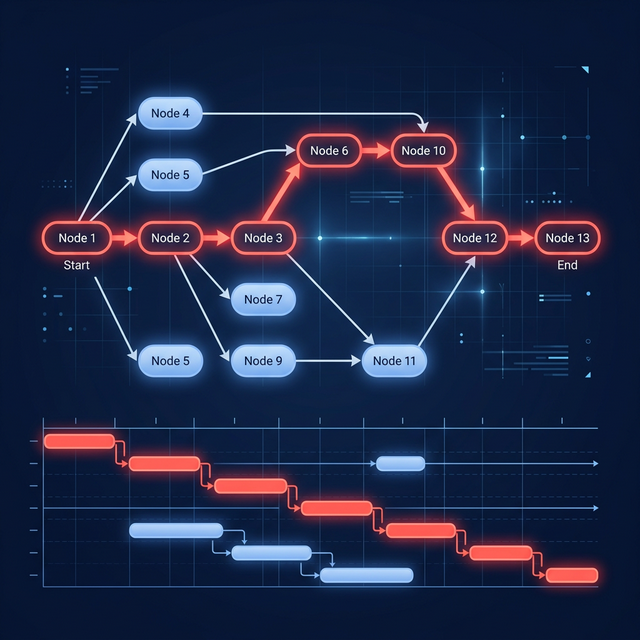
A schedule is an excellent detector because it forces a request to occupy time and connect to predecessors and successors. It is not the approval system by itself. For deeper schedule logic, see how dependency networks expose downstream impact and the four Gantt dependency types.
How do you prevent scope creep before work starts?
Prevent scope creep by making the project boundary testable before execution. A short baseline that people use is better than a large document nobody reads.
Record at least:
- the outcome and named deliverables;
- explicit exclusions and assumptions;
- acceptance criteria for each deliverable;
- a work breakdown structure at a level the team can estimate;
- the approved budget and key milestone dates;
- who may approve which class of change;
- where change requests are logged and how quickly they receive a decision.
Then connect the agreed work to a schedule. Each deliverable should have an owner, duration, predecessor logic, and acceptance milestone. Save a schedule baseline if the tool supports one. If it does not, preserve a dated export or named plan version; a version is less convenient than a visual baseline overlay, but it still creates traceability.
What change-control process stops scope creep without creating bureaucracy?
Use one form, one decision owner, and a risk-based approval threshold. A small team does not need an enterprise committee for every wording change, but it does need a consistent record.
| Field | Example entry | Why it matters |
|---|---|---|
| Request | Add SSO before launch | Makes the proposal concrete |
| Business reason | Required by signed enterprise customer | Separates value from preference |
| Deliverables affected | Authentication, admin settings, support docs | Reveals the real boundary |
| Schedule impact | +8 working days; release moves Aug 21 → Sep 2 | Makes time visible |
| Cost/resource impact | Identity specialist for 40 hours | Prevents invisible overtime |
| Risk impact | Reduces account risk; adds launch complexity | Shows both sides |
| Options | Add and move date; remove analytics; defer SSO | Gives the approver choices |
| Decision owner/date | Sponsor, Aug 10 | Establishes authority and traceability |
A lightweight flow is:
- Capture the request without promising delivery.
- Clarify the outcome and acceptance criteria.
- Estimate direct work and affected dependencies.
- Show the effect on the critical path, budget, resources, and risk.
- Offer tradeoffs—not only accept/reject.
- Obtain the named approver’s decision.
- Update the scope baseline, schedule, budget, backlog, and stakeholder message together.
APM describes change control as the process used for issues that modify scope or another part of the baseline plan. DOE similarly defines a change-control log as the document listing changes, status, and actions. The important behavior is synchronizing the records: approving a change in email while leaving the schedule unchanged creates a second version of truth.
How does a Gantt chart reveal the real cost of a “small” request?
A logic-linked Gantt chart shows which downstream dates move when new work enters the schedule. Consider a request to add one field to a customer profile:
| Affected work | Added effort | Dependency consequence |
|---|---|---|
| Product clarification | 0.5 day | Blocks design |
| UX and validation rules | 1 day | Blocks frontend and API contract |
| API/database change | 1.5 days | Blocks integration testing |
| Frontend change | 1 day | Blocks regression testing |
| Tests, docs, and release | 1.5 days | Moves the release milestone |
| Total | 5.5 days | Not the “quick field” first described |
If those activities have float, the final deadline may not move. If they sit on the critical path, the finish date moves unless the team changes sequence, capacity, or scope elsewhere. The chart turns an emotional negotiation into an explicit scheduling decision.
GanttFather can model FS, SS, FF, and SF dependencies with lag and show the current critical path. GanttFather does not currently provide a dedicated schedule-baseline overlay, so preserve an approved export or named version when formal baseline comparison is required. See the project baseline guide for the difference between a live forecast and an approved reference plan.
How do you recover after scope creep has already happened?
Stop accepting new work briefly, reconstruct the current scope, and force a sponsor-level tradeoff. Do not hide the variance by silently replacing the old baseline.
- Inventory all work in progress and completed work that was not in the approved scope.
- Separate mandatory changes from optional enhancements and gold plating.
- Re-estimate remaining work with the people who will deliver it.
- Rebuild dependency logic and calculate a credible forecast.
- Present options: move the date, add qualified capacity, remove scope, reduce quality/risk controls only with explicit acceptance, or stop the project.
- Approve a recovery plan and retain the original baseline for lessons learned.
Rebaselining can be legitimate after an approved major change. It must not erase the evidence that the original plan diverged. The DOE lexicon describes variance as a deviation from the approved scope, cost, or schedule baseline and says variances should be tracked and reported rather than eliminated.
How can GanttFather make a scope change’s schedule impact visible?
Preserve the approved schedule with an Excel export, then add the proposed activities, durations, and dependency links to the working plan before anyone promises a date. GanttFather can model FS, SS, FF, and SF relationships with lag and recalculate the critical path, so the approver can see whether the request consumes float or moves the finish milestone. Unlimited viewers and guests can review the live result while two editor seats control changes on the free owned project.
GanttFather supplies schedule evidence, not change authority. It has no dedicated baseline overlay or automatic resource leveling, so retain the dated export and keep the decision in the project’s change log. To test the process with a fictional request, create a free GanttFather project and compare the finish date before and after adding the new work.
Frequently asked questions
Is every new requirement scope creep?
No. A requirement added through the agreed change process is a controlled scope change. Scope creep is the unapproved or untraced expansion of work. A project can accept many legitimate changes without “creeping” if each change has visible authority, impact, funding, and updated records.
Who is responsible for preventing scope creep?
The sponsor owns major scope decisions, the project manager owns the control process, product or business owners clarify value, and the delivery team exposes effort and dependencies. No single person can prevent scope creep if stakeholders can bypass intake or if team members start unapproved work.
Can Agile teams have scope creep?
Yes. A flexible backlog does not mean unlimited work inside a fixed release. Agile teams control scope by ordering the backlog, defining sprint or release goals, making capacity visible, and trading new items against existing commitments. Unrecorded additions and invisible overtime are scope creep in any delivery method.
What is the best sentence to use when a stakeholder requests more work?
Use: “We can assess that change; before committing, we will show its effect on the date, cost, dependencies, and current priorities.” The sentence does not reject the request. It prevents a conversation from becoming authorization before the delivery impact is understood.
Does a Gantt chart prevent scope creep by itself?
No. A Gantt chart makes time and dependencies visible, but it cannot define business authority or enforce approval. Pair the schedule with a scope baseline, change log, acceptance criteria, and named decision owner. The chart supplies impact evidence; governance supplies the decision.
Sources
- U.S. Department of Energy, Project Management Lexicon of Terms
- Association for Project Management, What is change control?
- Association for Project Management, What is scope creep and how can we mitigate it?
- Project Management Institute, Controlling scope creep
- Project Management Institute, Practice Standard for Scheduling