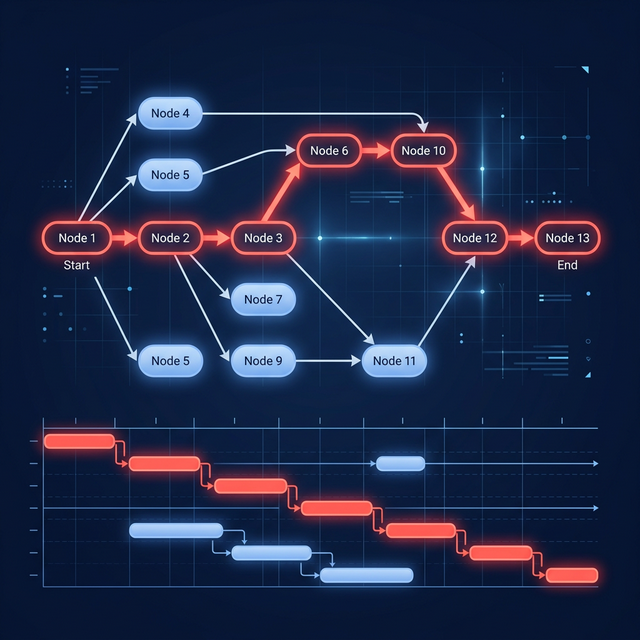
A reliable project schedule covers all work, uses valid logic, realistic resources and durations, traces to milestones, has credible critical path and float, addresses risk, and stays updated.
How can you tell whether a project schedule is reliable?
A reliable schedule is complete, logically connected, resource-aware, realistic, traceable, risk-informed, and regularly updated. Its finish date can be explained by the work and dependency network—not by manually arranging bars until they meet a desired deadline.
Use this 10-point checklist before approving a baseline, after major scope change, and during periodic schedule-health reviews. It adapts the ten scheduling best practices in the U.S. Government Accountability Office’s Schedule Assessment Guide into questions a delivery team can use.
The 10-point schedule quality checklist
| # | Quality test | Pass condition |
|---|---|---|
| 1 | Complete activities | All approved scope and necessary support work are represented |
| 2 | Valid sequence | Dependencies model real handoffs with few unexplained open ends |
| 3 | Assigned resources | Labor, equipment, and calendars make the work feasible |
| 4 | Credible durations | Estimates have evidence, assumptions, and suitable detail |
| 5 | Traceability | Detail rolls up consistently to milestones and commitments |
| 6 | Valid critical path | A continuous, plausible chain drives the finish |
| 7 | Reasonable float | Extreme or negative values are explained and actionable |
| 8 | Schedule risk analysis | Uncertainty and confidence in key dates are understood |
| 9 | Current status | Actuals and remaining work reflect the agreed status date |
| 10 | Baseline discipline | Approved history is preserved and variance is visible |
1. Does the schedule capture all the work?
Start from the approved scope and work breakdown structure. Include product work, integration, testing, approvals, procurement, transition, documentation, training, and project-management effort when they affect the forecast.
Look for missing work at phase boundaries. A schedule may show “Build complete” followed immediately by “Launch” while omitting data migration, security approval, operational readiness, and rollback preparation.
Evidence: every in-scope deliverable maps to one or more schedule activities, and exclusions are documented.
2. Are activities sequenced with valid logic?
Each detailed activity should normally have a predecessor and successor, except legitimate project starts and finishes. Review all four dependency types and any lag or lead.
Flag:
- tasks whose dates are manually fixed without an external reason;
- dangling activities that do not feed a completion milestone;
- long negative leads used to force overlap;
- redundant links that add no real constraint;
- lag that hides owner-performed work.
Evidence: the team can explain each material link as a real handoff or constraint.
3. Are resources assigned and available?
A network can be logically correct and physically impossible. Confirm that owners, specialist teams, equipment, environments, and calendars exist when required. Find people assigned to simultaneous full-time tasks and shared environments booked by several teams.
Evidence: material over-allocation is resolved or explicitly accepted, and resource assumptions are recorded. Where necessary, perform resource leveling or smoothing.
4. Are durations credible?
Durations should reflect the task’s scope, productivity, working calendar, and uncertainty. Very long activities hide progress; extremely short activities create maintenance noise.
Challenge estimates that are round placeholders, chosen to hit a deadline, or copied from unrelated work. Use historical evidence, expert judgment, analogous estimates, or three-point estimates for uncertain critical work.
Evidence: each critical or high-risk duration has an owner and a defensible basis.
5. Is the schedule traceable vertically and horizontally?
Vertical traceability means detailed dates roll up consistently to summary tasks, milestones, reports, and executive commitments. Horizontal traceability means dependencies connect work across teams and phases from start to finish.
If the executive roadmap says launch is October 1 but the detailed schedule ends October 8, the control system is inconsistent. If the software team finishes a component but no link connects it to integration testing, cross-team logic is incomplete.
Evidence: milestone dates agree across planning levels, and cross-team handoffs are connected.
6. Is the critical path valid?
The critical path should be a continuous, technically plausible sequence driving the project finish. Ask the activity owners to walk it from beginning to end.
Warning signs include:
- critical work created only by arbitrary date constraints;
- a path that stops before the finish milestone;
- almost every task marked critical;
- the critical path jumping after an unrelated update;
- obvious finish-driving work absent from the path.
Evidence: the team can explain why a delay on each critical activity can affect the finish and knows the near-critical alternatives.
7. Is total float reasonable?
Very large positive float often points to missing logic. Negative float indicates that the current network cannot meet a required date. Near-zero float across many paths means the schedule has little resilience.
Do not set one universal threshold. Interpret total and free float in the context of project duration, update cadence, calendars, and contractual milestones.
Evidence: extreme values are explained, low-float paths are monitored, and negative float has an approved response.
8. Has schedule risk been analyzed?
A single deterministic finish date can hide uncertainty. Identify risks that affect durations, logic, resource availability, or external approvals. For important commitments, use three-point estimates or Monte Carlo schedule-risk analysis to estimate confidence dates.
“P80 finish” means 80% of modeled outcomes finish on or before that date; it does not mean risk has disappeared. Model quality depends on realistic inputs and correlations.
Evidence: decision-makers understand both the forecast date and its confidence, with mitigation tied to the risks that drive it.
9. Is progress current and logically incorporated?
Set an explicit status date. Record actual starts and finishes, revise remaining duration, and correct future logic when the execution plan changes. Do not allow unfinished work to remain entirely in the past.
Check that percentage complete agrees with evidence. A task cannot be “complete” while its required deliverable is unaccepted. Update the critical path after status changes.
Evidence: the schedule represents reality as of the stated date, and material variance has a cause and owner.
10. Is the baseline preserved?
Keep the approved schedule baseline separate from the current forecast. Rebaseline only through an authorized change-control decision, preserving the original and the reason for revision.
Evidence: reports identify the baseline version, milestone variance is visible, and routine updates do not rewrite approved history.
A 15-minute schedule review agenda
For a weekly team review, use this order:
- Confirm the status date and changes since the last review.
- Review completed and late-starting tasks.
- Walk the current critical and near-critical paths.
- Inspect the next three milestones and their predecessor evidence.
- Resolve broken logic, resource conflicts, and missing owners.
- Record forecast changes, decisions, and escalation owners.
Do not read every row aloud. The schedule is a decision model; focus the meeting on changed forecasts and the work that can change them.
How can GanttFather support this schedule-quality checklist?
Use its task hierarchy to represent scope, FS/SS/FF/SF dependencies plus lag for logic, assignments for ownership, milestone markers for gates, critical-path highlighting for finish-driving work, version snapshots for approved points, and reports for current project health. Excel import/export helps reconcile the schedule with source data, while real-time sharing lets owners and reviewers inspect one current model. The free tier includes one owned project, two editor seats, and unlimited viewers and guests, which is enough to run the checklist with a small planning group and a wider review audience.
Some controls remain the planner’s responsibility. GanttFather does not currently run probabilistic schedule-risk analysis, automatically level resources, or display a dedicated baseline overlay. For high-consequence programs, pair the tool with the required control process and validate every invariant your governance demands.
Create a free GanttFather project and run the ten checks against a representative schedule before approving its dates.
Frequently asked questions
Does a beautiful Gantt chart mean the schedule is good?
No. Formatting can improve communication but cannot repair missing scope, false logic, impossible resources, or stale status. Quality lives in the model behind the bars.
How often should schedule quality be assessed?
Review basic health at every status cycle. Perform a deeper check before baseline approval, after major changes, before contractual commitments, and whenever the forecast behaves unexpectedly.
What percentage of tasks should be critical?
There is no universal correct percentage. An unusually high share can signal excessive constraints or no float; a suspiciously low share can signal missing logic. Inspect why the path exists.
Can an AI agent audit a schedule?
It can find structural symptoms—missing owners, open ends, long tasks, stale status, or unusual float—but humans must validate technical dependencies, acceptance evidence, risk, and resource feasibility.
Sources