See where AI assistants and agents help project teams today, where human review remains essential, and how to introduce agentic workflows safely.
AI is changing project management by reducing the effort needed to summarize information, draft plans, query schedule data, and execute bounded updates. The important shift is not from “chatbot” to infallible autonomous manager; it is from text generation to tool-using systems that can take actions under explicit permissions and review.
Reviewed August 7, 2026. This article makes no universal productivity claim: results depend on the model, data, workflow, controls, and quality of human review.
What is an AI agent in project management?
An AI assistant produces an answer or draft. An AI agent combines a model with tools, instructions, identity, and a loop that can observe results and choose another bounded action. In a project context, that might mean reading a schedule, finding late tasks, proposing a recovery plan, and—with permission—updating selected records.
The word autonomous is relative. A system may autonomously choose among approved tools while still requiring a person to confirm writes, spending, external messages, or irreversible changes.
Which project-management tasks can AI help with today?
The strongest current uses have clear inputs, inspectable outputs, and a human owner:
| Workflow | Useful AI contribution | Required control |
|---|---|---|
| Status reporting | Summarize task changes and blockers | Link every claim to current data |
| Schedule review | Find missing dates, weak logic, or low float | Planner validates assumptions |
| Meeting follow-up | Draft decisions and action items | Attendees confirm ownership |
| Risk discovery | Generate questions and scenarios | Team assesses probability and impact |
| Task creation | Convert an approved plan into records | Preview or scoped write permission |
| Stakeholder updates | Adapt a verified summary to an audience | Named sender approves external message |
AI is less dependable when the goal is ambiguous, source data is incomplete, politics matter, or an error would create an irreversible external effect.
What changes when an agent can use tools?
Tool access changes the risk. A hallucinated paragraph is inconvenient; a hallucinated delete, reassignment, or deadline change alters shared state. Design agent workflows around least privilege, stable ids, validation, idempotency for retryable creates, audit history, and clear error handling.
Separate three modes:
- Read: inspect and summarize without changing state.
- Propose: produce a specific diff or plan for review.
- Act: execute only the approved, scoped operation.
Do not grant write permission merely because a read-only pilot produced useful summaries.
What should remain a human responsibility?
Humans remain accountable for business purpose, ethical judgment, negotiation, organizational commitments, and risk acceptance. A model cannot know whether a politically sensitive delay should be escalated, whether a supplier’s explanation is credible, or whether the project should exist at all unless people provide and validate that context.
Human review is especially important for:
- approving scope, budget, or deadline changes
- interpreting incomplete or contradictory evidence
- handling personnel and performance matters
- external communication and contractual commitments
- safety, privacy, security, legal, and regulatory decisions
- deciding when the model’s confidence is not good enough
How should a team introduce AI agents safely?
Start with a narrow read-only job and a measurable failure definition. Use representative but non-sensitive data. Record the prompt, tools, model, inputs, outputs, human corrections, and time saved or added.
Then move through staged permissions:
- read-only schedule question
- draft recommendation with cited records
- proposed change set
- confirmed low-risk write
- limited automation with monitoring and rollback
The NIST AI Risk Management Framework recommends managing AI risk across governance, mapping, measurement, and management activities. Apply that lifecycle rather than treating a successful demo as production assurance.
Will agents make project plans more accurate?
They can make consistency checks cheaper and surface patterns a person may miss. They cannot turn missing evidence into truth. If durations are political guesses, dependencies are absent, or status is stale, an agent may produce a polished but false answer faster.
Measure accuracy against a defined reference: Was the cited task current? Did the proposed dependency exist? Did the write affect only the authorized project? Could the action be traced and reversed?
When is GanttFather a useful workspace for AI agents?
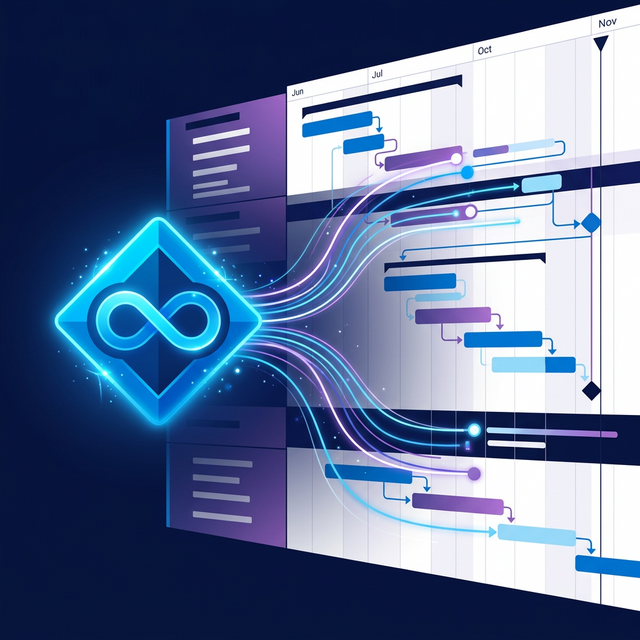
GanttFather exposes project tools through the Model Context Protocol and a versioned REST API. An authorized agent can inspect projects and tasks, work with dependencies and resources, and run supported schedule analysis while the same plan remains visible to the team.
The agent is still constrained by its token, project permissions, and available tools. MCP critical-path analysis currently assumes finish-to-start logic, so a plan using SS, FF, or SF relationships requires human interpretation. GanttFather also does not provide automatic resource leveling or a dedicated baseline overlay.
Create a test project in GanttFather, begin with read-only access, and compare the agent’s answer with the visible schedule before enabling writes.
Frequently asked questions
Is an AI agent the same as a chatbot?
No. A chatbot may only generate text. An agent can be given tools and permission to read or change external systems, often across multiple steps.
Can an AI agent manage a project without a project manager?
It can automate bounded workflows, but it cannot own organizational accountability, negotiate commitments, or independently accept business risk.
What is the safest first use case?
A read-only summary or schedule-quality check with cited source records and a human reviewer.
Should agents have broad account access?
No by default. Use least-privilege tokens, narrow project scope, and read-only permission until a specific write use case is proven.
How do you measure an AI project workflow?
Measure correctness, review effort, failure severity, unauthorized-change rate, traceability, and recovery—not only speed or volume.
Does MCP make an AI model accurate?
No. MCP standardizes how a client discovers and invokes tools. Accuracy still depends on the model, data, tool implementation, instructions, and review.